DAVE, or Digital Application Virtual Engineer, is a software development and code generation tool for microcontroller applications created in C/C++. == Versions == === Version 4 (beta) === The successor of the Eclipse-based development environment for C/C++ and/or graphical user interface (GUI) based development using application software (apps). It generates code for the latest XMC1xxx and XMC4xxx microcontrollers using ARM Cortex-M processors. DAVE software development kit (SDK) is a free integrated development environment to set up its own apps for DAVE. === Version 3 === Automatic code generation is based on the use of case-oriented, configurable, and tested software (SW) components, called DAVE Apps. They are comparable to executable and configurable application notes that can be downloaded from the web. The environment is based on Eclipse. Ordinary program development using C/C++ is also available. The targets for this development are XMC1xxx and XMC4xxx microcontrollers that use Cortex-M processors. === Previous versions === This version targets 32-bit microcontroller units (MCUs) (Infineon TriCore AUDO family), 16-bit MCUs (C166, XC166, XE166, and XC2000 family), and 8-bit MCUs (XC800 family) from Infineon. After the initial setup, the configuration wizard appears and gives an overview of the hardware peripherals, control units, and modules. The microcontroller application can be created by selecting the desired functions. At this step, module-specific functions must be selected for module initializing and control. Finally, the application source files will be generated by DAVE and embedded in a project in the selected development environment, where the code can still be modified or added to an extant project. == DAVE-related software == Infineon also developed additional software that can be used in conjunction with DAVE for specific microcontroller families or additional hardware: DAVE Bench for XC800 is a platform providing free development tools for Infineon's 8-bit microcontroller family, based on the Open Source Eclipse architecture. DAVE Drive is a GUI-based software tool that allows application developers to create embedded software for the control of brushless synchronous three-phase motors. == Alternative software == The Infineon MCUs are directly supported by several commercial products, depending on the selected MCU target. An embedded programming library for MATLAB exists. As a free alternative to DAVE, the developer can use the Keil Microcontroller Development Kit (MDK) Version 5. Code for the XMX1000 series up to 128 kB can be developed this way without purchasing a license from Keil.
Clipping (computer graphics)
Clipping, in the context of computer graphics, is a method to selectively enable or disable rendering operations within a defined region of interest. Mathematically, clipping can be described using the terminology of constructive geometry. A rendering algorithm only draws pixels in the intersection between the clip region and the scene model. Lines and surfaces outside the view volume (aka. frustum) are removed. Clip regions are commonly specified to improve render performance. Pixels that will be drawn are said to be within the clip region. Pixels that will not be drawn are outside the clip region. More informally, pixels that will not be drawn are said to be "clipped." == In 2D graphics == In two-dimensional graphics, a clip region may be defined so that pixels are only drawn within the boundaries of a window or frame. Clip regions can also be used to selectively control pixel rendering for aesthetic or artistic purposes. In many implementations, the final clip region is the composite (or intersection) of one or more application-defined shapes, as well as any system hardware constraints In one example application, consider an image editing program. A user application may render the image into a viewport. As the user zooms and scrolls to view a smaller portion of the image, the application can set a clip boundary so that pixels outside the viewport are not rendered. In addition, GUI widgets, overlays, and other windows or frames may obscure some pixels from the original image. In this sense, the clip region is the composite of the application-defined "user clip" and the "device clip" enforced by the system's software and hardware implementation. Application software can take advantage of this clip information to save computation time, energy, and memory, avoiding work related to pixels that aren't visible. == In 3D graphics == In three-dimensional graphics, the terminology of clipping can be used to describe many related features. Typically, "clipping" refers to operations in the plane that work with rectangular shapes, and "culling" refers to more general methods to selectively process scene model elements. This terminology is not rigid, and exact usage varies among many sources. Scene model elements include geometric primitives: points or vertices; line segments or edges; polygons or faces; and more abstract model objects such as curves, splines, surfaces, and even text. In complicated scene models, individual elements may be selectively disabled (clipped) for reasons including visibility within the viewport (frustum culling); orientation (backface culling), obscuration by other scene or model elements (occlusion culling, depth- or "z" clipping). Sophisticated algorithms exist to efficiently detect and perform such clipping. Many optimized clipping methods rely on specific hardware acceleration logic provided by a graphics processing unit (GPU). The concept of clipping can be extended to higher dimensionality using methods of abstract algebraic geometry. === Near clipping === Beyond projection of vertices & 2D clipping, near clipping is required to correctly rasterise 3D primitives; this is because vertices may have been projected behind the eye. Near clipping ensures that all the vertices used have valid 2D coordinates. Together with far-clipping it also helps prevent overflow of depth-buffer values. Some early texture mapping hardware (using forward texture mapping) in video games suffered from complications associated with near clipping and UV coordinates. === Occlusion clipping (Z- or depth clipping) === In 3D computer graphics, "Z" often refers to the depth axis in the system of coordinates centered at the viewport origin: "Z" is used interchangeably with "depth", and conceptually corresponds to the distance "into the virtual screen." In this coordinate system, "X" and "Y" therefore refer to a conventional cartesian coordinate system laid out on the user's screen or viewport. This viewport is defined by the geometry of the viewing frustum, and parameterizes the field of view. Z-clipping, or depth clipping, refers to techniques that selectively render certain scene objects based on their depth relative to the screen. Most graphics toolkits allow the programmer to specify a "near" and "far" clip depth, and only portions of objects between those two planes are displayed. A creative application programmer can use this method to render visualizations of the interior of a 3D object in the scene. For example, a medical imaging application could use this technique to render the organs inside a human body. A video game programmer can use clipping information to accelerate game logic. For example, a tall wall or building that occludes other game entities can save GPU time that would otherwise be spent transforming and texturing items in the rear areas of the scene; and a tightly integrated software program can use this same information to save CPU time by optimizing out game logic for objects that aren't seen by the player. == Algorithms == Line clipping algorithms: Cohen–Sutherland Liang–Barsky Fast-clipping Cyrus–Beck Nicholl–Lee–Nicholl Skala O(lg N) algorithm Polygon clipping algorithms: Greiner–Hormann Sutherland–Hodgman Weiler–Atherton Vatti Rendering methodologies Painter's algorithm
Smart object
A smart object is an object that enhances the interaction with not only people but also with other smart objects. Also known as smart connected products or smart connected things (SCoT), they are products, assets and other things embedded with processors, sensors, software and connectivity that allow data to be exchanged between the product and its environment, manufacturer, operator/user, and other products and systems. Connectivity also enables some capabilities of the product to exist outside the physical device, in what is known as the product cloud. The data collected from these products can be then analysed to inform decision-making, enable operational efficiencies and continuously improve the performance of the product. It can not only refer to interaction with physical world objects but also to interaction with virtual (computing environment) objects. A smart physical object may be created either as an artifact or manufactured product or by embedding electronic tags such as RFID tags or sensors into non-smart physical objects. Smart virtual objects are created as software objects that are intrinsic when creating and operating a virtual or cyber world simulation or game. The concept of a smart object has several origins and uses, see History. There are also several overlapping terms, see also smart device, tangible object or tangible user interface and Thing as in the Internet of things. == History == In the early 1990s, Mark Weiser, from whom the term ubiquitous computing originated, referred to a vision "When almost every object either contains a computer or can have a tab attached to it, obtaining information will be trivial", Although Weiser did not specifically refer to an object as being smart, his early work did imply that smart physical objects are smart in the sense that they act as digital information sources. Hiroshi Ishii and Brygg Ullmer refer to tangible objects in terms of tangibles bits or tangible user interfaces that enable users to "grasp & manipulate" bits in the center of users' attention by coupling the bits with everyday physical objects and architectural surfaces. The smart object concept was introduced by Marcelo Kallman and Daniel Thalmann as an object that can describe its own possible interactions. The main focus here is to model interactions of smart virtual objects with virtual humans, agents, in virtual worlds. The opposite approach to smart objects is 'plain' objects that do not provide this information. The additional information provided by this concept enables far more general interaction schemes, and can greatly simplify the planner of an artificial intelligence agent. In contrast to smart virtual objects used in virtual worlds, Lev Manovich focuses on physical space filled with electronic and visual information. Here, "smart objects" are described as "objects connected to the Net; objects that can sense their users and display smart behaviour". More recently in the early 2010s, smart objects are being proposed as a key enabler for the vision of the Internet of things. The combination of the Internet and emerging technologies such as near field communications, real-time localization, and embedded sensors enables everyday objects to be transformed into smart objects that can understand and react to their environment. Such objects are building blocks for the Internet of things and enable novel computing applications. In 2018, one of the world's first smart houses was built in Klaukkala, Finland in the form of a five-floor apartment block, using the Kone Residential Flow solution created by KONE, allowing even a smartphone to act as a home key. == Characteristics == Although we can view interaction with physical smart object in the physical world as distinct from interaction with virtual smart objects in a virtual simulated world, these can be related. Poslad considers the progression of: how humans use models of smart objects situated in the physical world to enhance human to physical world interaction; versus how smart physical objects situated in the physical world can model human interaction in order to lessen the need for human to physical world interaction; versus how virtual smart objects by modelling both physical world objects and modelling humans as objects and their subsequent interactions can form a predominantly smart virtual object environment. === Smart physical objects === The concept smart for a smart physical object simply means that it is active, digital, networked, can operate to some extent autonomously, is reconfigurable and has local control of the resources it needs such as energy, data storage, etc. Note, a smart object does not necessarily need to be intelligent as in exhibiting a strong essence of artificial intelligence—although it can be designed to also be intelligent. Physical world smart objects can be described in terms of three properties: Awareness: is a smart object's ability to understand (that is, sense, interpret, and react to) events and human activities occurring in the physical world. Representation: refers to a smart object's application and programming model—in particular, programming abstractions. Interaction: denotes the object's ability to converse with the user in terms of input, output, control, and feedback. Based upon these properties, these have been classified into three types: Activity-Aware Smart Objects: Are objects that can record information about work activities and its own use. Policy-Aware Smart Objects: Are objects that are activity-aware Objects can interpret events and activities with respect to predefined organizational policies. Process-Aware Smart Objects: Processes play a fundamental role in industrial work management and operation. A process is a collection of related activities or tasks that are ordered according to their position in time and space. === Smart virtual objects === For the virtual object in a virtual world case, an object is called smart when it has the ability to describe its possible interactions. This focuses on constructing a virtual world using only virtual objects that contain their own interaction information. There are four basic elements to constructing such a smart virtual object framework. Object properties: physical properties and a text description Interaction information: position of handles, buttons, grips, and the like Object behavior: different behaviors based on state variables Agent behaviors: description of the behavior an agent should follow when using the object Some versions of smart objects also include animation information in the object information, but this is not considered to be an efficient approach, since this can make objects inappropriately oversized. === Categorization === The terms smart, connected product or smart product can be confusing as it is used to cover a broad range of different products, ranging from smart home appliances (e.g., smart bathroom scales or smart light bulbs) to smart cars (e.g., Tesla). While these products share certain similarities, they often differ substantially in their capabilities. Raff et al. developed a conceptual framework that distinguishes different smart products based on their capabilities, which features 4 types of smart product archetypes (in ascending order of "smartness"). Digital Connected Responsive Intelligent == Advantages == Smart, connected products have three primary components: Physical – made up of the product's mechanical and electrical parts. Smart – made up of sensors, microprocessors, data storage, controls, software, and an embedded operating system with enhanced user interface. Connectivity – made up of ports, antennae, and protocols enabling wired/wireless connections that serve two purposes, it allows data to be exchanged with the product and enables some functions of the product to exist outside the physical device. Each component expands the capabilities of one another resulting in "a virtuous cycle of value improvement". First, the smart components of a product amplify the value and capabilities of the physical components. Then, connectivity amplifies the value and capabilities of the smart components. These improvements include: Monitoring of the product's conditions, its external environment, and its operations and usage. Control of various product functions to better respond to changes in its environment, as well as to personalize the user experience. Optimization of the product's overall operations based on actual performance data, and reduction of downtimes through predictive maintenance and remote service. Autonomous product operation, including learning from their environment, adapting to users' preferences and self-diagnosing and service. === The Internet of things (IoT) === The Internet of things is the network of physical objects that contain embedded technology to communicate and sense or interact with their internal states or the external environment. The phrase "Internet of things" reflects the gro
Learning to rank
Learning to rank (LTR) or machine-learned ranking (MLR) is the application of machine learning, often supervised, semi-supervised or reinforcement learning, in the construction of ranking models for information retrieval and recommender systems. Training data may, for example, consist of lists of items with some partial order specified between items in each list. This order is typically induced by giving a numerical or ordinal score or a binary judgment (e.g. "relevant" or "not relevant") for each item. The goal of constructing the ranking model is to rank new, unseen lists in a similar way to rankings in the training data. == Applications == === In information retrieval === Ranking is a central part of many information retrieval problems, such as document retrieval, collaborative filtering, sentiment analysis, and online advertising. A possible architecture of a machine-learned search engine is shown in the accompanying figure. Training data consists of queries and documents matching them together with the relevance degree of each match. It may be prepared manually by human assessors (or raters, as Google calls them), who check results for some queries and determine relevance of each result. It is not feasible to check the relevance of all documents, and so typically a technique called pooling is used — only the top few documents, retrieved by some existing ranking models are checked. This technique may introduce selection bias. Alternatively, training data may be derived automatically by analyzing clickthrough logs (i.e. search results which got clicks from users), query chains, or such search engines' features as Google's (since-replaced) SearchWiki. Clickthrough logs can be biased by the tendency of users to click on the top search results on the assumption that they are already well-ranked. Training data is used by a learning algorithm to produce a ranking model which computes the relevance of documents for actual queries. Typically, users expect a search query to complete in a short time (such as a few hundred milliseconds for web search), which makes it impossible to evaluate a complex ranking model on each document in the corpus, and so a two-phase scheme is used. First, a small number of potentially relevant documents are identified using simpler retrieval models which permit fast query evaluation, such as the vector space model, Boolean model, weighted AND, or BM25. This phase is called top- k {\displaystyle k} document retrieval and many heuristics were proposed in the literature to accelerate it, such as using a document's static quality score and tiered indexes. In the second phase, a more accurate but computationally expensive machine-learned model is used to re-rank these documents. === In other areas === Learning to rank algorithms have been applied in areas other than information retrieval: In machine translation for ranking a set of hypothesized translations; In computational biology for ranking candidate 3-D structures in protein structure prediction problems; In recommender systems for identifying a ranked list of related news articles to recommend to a user after he or she has read a current news article. == Feature vectors == For the convenience of MLR algorithms, query-document pairs are usually represented by numerical vectors, which are called feature vectors. Such an approach is sometimes called bag of features and is analogous to the bag of words model and vector space model used in information retrieval for representation of documents. Components of such vectors are called features, factors or ranking signals. They may be divided into three groups (features from document retrieval are shown as examples): Query-independent or static features — those features, which depend only on the document, but not on the query. For example, PageRank or document's length. Such features can be precomputed in off-line mode during indexing. They may be used to compute document's static quality score (or static rank), which is often used to speed up search query evaluation. Query-dependent or dynamic features — those features, which depend both on the contents of the document and the query, such as TF-IDF score or other non-machine-learned ranking functions. Query-level features or query features, which depend only on the query. For example, the number of words in a query. Some examples of features, which were used in the well-known LETOR dataset: TF, TF-IDF, BM25, and language modeling scores of document's zones (title, body, anchors text, URL) for a given query; Lengths and IDF sums of document's zones; Document's PageRank, HITS ranks and their variants. Selecting and designing good features is an important area in machine learning, which is called feature engineering. == Evaluation measures == There are several measures (metrics) which are commonly used to judge how well an algorithm is doing on training data and to compare the performance of different MLR algorithms. Often a learning-to-rank problem is reformulated as an optimization problem with respect to one of these metrics. Examples of ranking quality measures: Mean average precision (MAP); DCG and NDCG; Precision@n, NDCG@n, where "@n" denotes that the metrics are evaluated only on top n documents; Mean reciprocal rank; Kendall's tau; Spearman's rho. DCG and its normalized variant NDCG are usually preferred in academic research when multiple levels of relevance are used. Other metrics such as MAP, MRR and precision, are defined only for binary judgments. Recently, there have been proposed several new evaluation metrics which claim to model user's satisfaction with search results better than the DCG metric: Expected reciprocal rank (ERR); Yandex's pfound. Both of these metrics are based on the assumption that the user is more likely to stop looking at search results after examining a more relevant document, than after a less relevant document. == Approaches == Learning to Rank approaches are often categorized using one of three approaches: pointwise (where individual documents are ranked), pairwise (where pairs of documents are ranked into a relative order), and listwise (where an entire list of documents are ordered). Tie-Yan Liu of Microsoft Research Asia has analyzed existing algorithms for learning to rank problems in his book Learning to Rank for Information Retrieval. He categorized them into three groups by their input spaces, output spaces, hypothesis spaces (the core function of the model) and loss functions: the pointwise, pairwise, and listwise approach. In practice, listwise approaches often outperform pairwise approaches and pointwise approaches. This statement was further supported by a large scale experiment on the performance of different learning-to-rank methods on a large collection of benchmark data sets. In this section, without further notice, x {\displaystyle x} denotes an object to be evaluated, for example, a document or an image, f ( x ) {\displaystyle f(x)} denotes a single-value hypothesis, h ( ⋅ ) {\displaystyle h(\cdot )} denotes a bi-variate or multi-variate function and L ( ⋅ ) {\displaystyle L(\cdot )} denotes the loss function. === Pointwise approach === In this case, it is assumed that each query-document pair in the training data has a numerical or ordinal score. Then the learning-to-rank problem can be approximated by a regression problem — given a single query-document pair, predict its score. Formally speaking, the pointwise approach aims at learning a function f ( x ) {\displaystyle f(x)} predicting the real-value or ordinal score of a document x {\displaystyle x} using the loss function L ( f ; x j , y j ) {\displaystyle L(f;x_{j},y_{j})} . A number of existing supervised machine learning algorithms can be readily used for this purpose. Ordinal regression and classification algorithms can also be used in pointwise approach when they are used to predict the score of a single query-document pair, and it takes a small, finite number of values. === Pairwise approach === In this case, the learning-to-rank problem is approximated by a classification problem — learning a binary classifier h ( x u , x v ) {\displaystyle h(x_{u},x_{v})} that can tell which document is better in a given pair of documents. The classifier shall take two documents as its input and the goal is to minimize a loss function L ( h ; x u , x v , y u , v ) {\displaystyle L(h;x_{u},x_{v},y_{u,v})} . The loss function typically reflects the number and magnitude of inversions in the induced ranking. In many cases, the binary classifier h ( x u , x v ) {\displaystyle h(x_{u},x_{v})} is implemented with a scoring function f ( x ) {\displaystyle f(x)} . As an example, RankNet adapts a probability model and defines h ( x u , x v ) {\displaystyle h(x_{u},x_{v})} as the estimated probability of the document x u {\displaystyle x_{u}} has higher quality than x v {\displaystyle x_{v}} : P u , v ( f ) = CDF ( f ( x u ) − f ( x v ) ) , {\displaystyle P_{u,v}(f)={\text{CDF}
Evolvability (computer science)
The term evolvability is a framework of computational learning introduced by Leslie Valiant in his paper of the same name. The aim of this theory is to model biological evolution and categorize which types of mechanisms are evolvable. Evolution is an extension of PAC learning and learning from statistical queries. == General framework == Let F n {\displaystyle F_{n}\,} and R n {\displaystyle R_{n}\,} be collections of functions on n {\displaystyle n\,} variables. Given an ideal function f ∈ F n {\displaystyle f\in F_{n}} , the goal is to find by local search a representation r ∈ R n {\displaystyle r\in R_{n}} that closely approximates f {\displaystyle f\,} . This closeness is measured by the performance Perf ( f , r ) {\displaystyle \operatorname {Perf} (f,r)} of r {\displaystyle r\,} with respect to f {\displaystyle f\,} . As is the case in the biological world, there is a difference between genotype and phenotype. In general, there can be multiple representations (genotypes) that correspond to the same function (phenotype). That is, for some r , r ′ ∈ R n {\displaystyle r,r'\in R_{n}} , with r ≠ r ′ {\displaystyle r\neq r'\,} , still r ( x ) = r ′ ( x ) {\displaystyle r(x)=r'(x)\,} for all x ∈ X n {\displaystyle x\in X_{n}} . However, this need not be the case. The goal then, is to find a representation that closely matches the phenotype of the ideal function, and the spirit of the local search is to allow only small changes in the genotype. Let the neighborhood N ( r ) {\displaystyle N(r)\,} of a representation r {\displaystyle r\,} be the set of possible mutations of r {\displaystyle r\,} . For simplicity, consider Boolean functions on X n = { − 1 , 1 } n {\displaystyle X_{n}=\{-1,1\}^{n}\,} , and let D n {\displaystyle D_{n}\,} be a probability distribution on X n {\displaystyle X_{n}\,} . Define the performance in terms of this. Specifically, Perf ( f , r ) = ∑ x ∈ X n f ( x ) r ( x ) D n ( x ) . {\displaystyle \operatorname {Perf} (f,r)=\sum _{x\in X_{n}}f(x)r(x)D_{n}(x).} Note that Perf ( f , r ) = Prob ( f ( x ) = r ( x ) ) − Prob ( f ( x ) ≠ r ( x ) ) . {\displaystyle \operatorname {Perf} (f,r)=\operatorname {Prob} (f(x)=r(x))-\operatorname {Prob} (f(x)\neq r(x)).} In general, for non-Boolean functions, the performance will not correspond directly to the probability that the functions agree, although it will have some relationship. Throughout an organism's life, it will only experience a limited number of environments, so its performance cannot be determined exactly. The empirical performance is defined by Perf s ( f , r ) = 1 s ∑ x ∈ S f ( x ) r ( x ) , {\displaystyle \operatorname {Perf} _{s}(f,r)={\frac {1}{s}}\sum _{x\in S}f(x)r(x),} where S {\displaystyle S\,} is a multiset of s {\displaystyle s\,} independent selections from X n {\displaystyle X_{n}\,} according to D n {\displaystyle D_{n}\,} . If s {\displaystyle s\,} is large enough, evidently Perf s ( f , r ) {\displaystyle \operatorname {Perf} _{s}(f,r)} will be close to the actual performance Perf ( f , r ) {\displaystyle \operatorname {Perf} (f,r)} . Given an ideal function f ∈ F n {\displaystyle f\in F_{n}} , initial representation r ∈ R n {\displaystyle r\in R_{n}} , sample size s {\displaystyle s\,} , and tolerance t {\displaystyle t\,} , the mutator Mut ( f , r , s , t ) {\displaystyle \operatorname {Mut} (f,r,s,t)} is a random variable defined as follows. Each r ′ ∈ N ( r ) {\displaystyle r'\in N(r)} is classified as beneficial, neutral, or deleterious, depending on its empirical performance. Specifically, r ′ {\displaystyle r'\,} is a beneficial mutation if Perf s ( f , r ′ ) − Perf s ( f , r ) ≥ t {\displaystyle \operatorname {Perf} _{s}(f,r')-\operatorname {Perf} _{s}(f,r)\geq t} ; r ′ {\displaystyle r'\,} is a neutral mutation if − t < Perf s ( f , r ′ ) − Perf s ( f , r ) < t {\displaystyle -t<\operatorname {Perf} _{s}(f,r')-\operatorname {Perf} _{s}(f,r)
Behavior-based robotics
Behavior-based robotics (BBR) or behavioral robotics is an approach in robotics that focuses on robots that are able to exhibit complex-appearing behaviors despite little internal variable state to model its immediate environment, mostly gradually correcting its actions via sensory-motor links. == Principles == Behavior-based robotics sets itself apart from traditional artificial intelligence by using biological systems as a model. Classic artificial intelligence typically uses a set of steps to solve problems, it follows a path based on internal representations of events compared to the behavior-based approach. Rather than use preset calculations to tackle a situation, behavior-based robotics relies on adaptability. This advancement has allowed behavior-based robotics to become commonplace in researching and data gathering. Most behavior-based systems are also reactive, which means they need no programming of what a chair looks like, or what kind of surface the robot is moving on. Instead, all the information is gleaned from the input of the robot's sensors. The robot uses that information to gradually correct its actions according to the changes in immediate environment. Behavior-based robots (BBR) usually show more biological-appearing actions than their computing-intensive counterparts, which are very deliberate in their actions. A BBR often makes mistakes, repeats actions, and appears confused, but can also show the anthropomorphic quality of tenacity. Comparisons between BBRs and insects are frequent because of these actions. BBRs are sometimes considered examples of weak artificial intelligence, although some have claimed they are models of all intelligence. == Features == Most behavior-based robots are programmed with a basic set of features to start them off. They are given a behavioral repertoire to work with dictating what behaviors to use and when, obstacle avoidance and battery charging can provide a foundation to help the robots learn and succeed. Rather than build world models, behavior-based robots simply react to their environment and problems within that environment. They draw upon internal knowledge learned from their past experiences combined with their basic behaviors to resolve problems. == History == The school of behavior-based robots owes much to work undertaken in the 1980s at the Massachusetts Institute of Technology by Rodney Brooks, who with students and colleagues built a series of wheeled and legged robots utilizing the subsumption architecture. Brooks' papers, often written with lighthearted titles such as "Planning is just a way of avoiding figuring out what to do next", the anthropomorphic qualities of his robots, and the relatively low cost of developing such robots, popularized the behavior-based approach. Brooks' work builds—whether by accident or not—on two prior milestones in the behavior-based approach. In the 1950s, W. Grey Walter, an English scientist with a background in neurological research, built a pair of vacuum tube-based robots that were exhibited at the 1951 Festival of Britain, and which have simple but effective behavior-based control systems. The second milestone is Valentino Braitenberg's 1984 book, "Vehicles – Experiments in Synthetic Psychology" (MIT Press). He describes a series of thought experiments demonstrating how simply wired sensor/motor connections can result in some complex-appearing behaviors such as fear and love. Later work in BBR is from the BEAM robotics community, which has built upon the work of Mark Tilden. Tilden was inspired by the reduction in the computational power needed for walking mechanisms from Brooks' experiments (which used one microcontroller for each leg), and further reduced the computational requirements to that of logic chips, transistor-based electronics, and analog circuit design. A different direction of development includes extensions of behavior-based robotics to multi-robot teams. The focus in this work is on developing simple generic mechanisms that result in coordinated group behavior, either implicitly or explicitly.
Developmental robotics
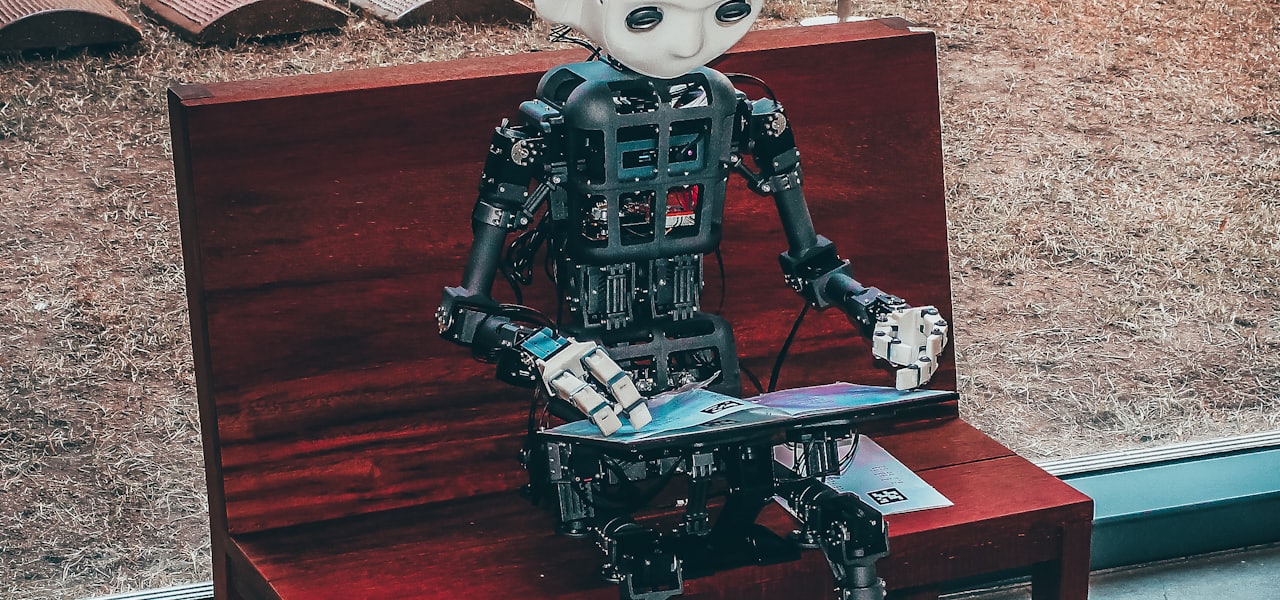
Developmental robotics (DevRob), sometimes called epigenetic robotics, is a scientific field which aims at studying the developmental mechanisms, architectures and constraints that allow lifelong and open-ended learning of new skills and new knowledge in embodied machines. As in human children, learning is expected to be cumulative and of progressively increasing complexity, and to result from self-exploration of the world in combination with social interaction. The typical methodological approach consists in starting from theories of human and animal development elaborated in fields such as developmental psychology, neuroscience, developmental and evolutionary biology, and linguistics, then to formalize and implement them in robots, sometimes exploring extensions or variants of them. The experimentation of those models in robots allows researchers to confront them with reality, and as a consequence, developmental robotics also provides feedback and novel hypotheses on theories of human and animal development. Developmental robotics is related to but differs from evolutionary robotics (ER). ER uses populations of robots that evolve over time, whereas DevRob is interested in how the organization of a single robot's control system develops through experience, over time. DevRob is also related to work done in the domains of robotics and artificial life. == Background == Can a robot learn like a child? Can it learn a variety of new skills and new knowledge unspecified at design time and in a partially unknown and changing environment? How can it discover its body and its relationships with the physical and social environment? How can its cognitive capacities continuously develop without the intervention of an engineer once it is "out of the factory"? What can it learn through natural social interactions with humans? These are the questions at the center of developmental robotics. Alan Turing, as well as a number of other pioneers of cybernetics, already formulated those questions and the general approach in 1950, but it is only since the end of the 20th century that they began to be investigated systematically. Because the concept of adaptive intelligent machines is central to developmental robotics, it has relationships with fields such as artificial intelligence, machine learning, cognitive robotics or computational neuroscience. Yet, while it may reuse some of the techniques elaborated in these fields, it differs from them from many perspectives. It differs from classical artificial intelligence because it does not assume the capability of advanced symbolic reasoning and focuses on embodied and situated sensorimotor and social skills rather than on abstract symbolic problems. It differs from cognitive robotics because it focuses on the processes that allow the formation of cognitive capabilities rather than these capabilities themselves. It differs from computational neuroscience because it focuses on functional modeling of integrated architectures of development and learning. More generally, developmental robotics is uniquely characterized by the following three features: It targets task-independent architectures and learning mechanisms, i.e. the machine/robot has to be able to learn new tasks that are unknown by the engineer; It emphasizes open-ended development and lifelong learning, i.e. the capacity of an organism to acquire continuously novel skills. This should not be understood as a capacity for learning "anything" or even “everything”, but just that the set of skills that is acquired can be infinitely extended at least in some (not all) directions; The complexity of acquired knowledge and skills shall increase (and the increase be controlled) progressively. Developmental robotics emerged at the crossroads of several research communities including embodied artificial intelligence, enactive and dynamical systems cognitive science, connectionism. Starting from the essential idea that learning and development happen as the self-organized result of the dynamical interactions among brains, bodies and their physical and social environment, and trying to understand how this self-organization can be harnessed to provide task-independent lifelong learning of skills of increasing complexity, developmental robotics strongly interacts with fields such as developmental psychology, developmental and cognitive neuroscience, developmental biology (embryology), evolutionary biology, and cognitive linguistics. As many of the theories coming from these sciences are verbal and/or descriptive, this implies a crucial formalization and computational modeling activity in developmental robotics. These computational models are then not only used as ways to explore how to build more versatile and adaptive machines but also as a way to evaluate their coherence and possibly explore alternative explanations for understanding biological development. == Research directions == === Skill domains === Due to the general approach and methodology, developmental robotics projects typically focus on having robots develop the same types of skills as human infants. A first category that is important being investigated is the acquisition of sensorimotor skills. These include the discovery of one's own body, including its structure and dynamics such as hand-eye coordination, locomotion, and interaction with objects as well as tool use, with a particular focus on the discovery and learning of affordances. A second category of skills targeted by developmental robots are social and linguistic skills: the acquisition of simple social behavioural games such as turn-taking, coordinated interaction, lexicons, syntax and grammar, and the grounding of these linguistic skills into sensorimotor skills (sometimes referred as symbol grounding). In parallel, the acquisition of associated cognitive skills are being investigated such as the emergence of the self/non-self distinction, the development of attentional capabilities, of categorization systems and higher-level representations of affordances or social constructs, of the emergence of values, empathy, or theories of mind. === Mechanisms and constraints === The sensorimotor and social spaces in which humans and robot live are so large and complex that only a small part of potentially learnable skills can actually be explored and learnt within a life-time. Thus, mechanisms and constraints are necessary to guide developmental organisms in their development and control of the growth of complexity. There are several important families of these guiding mechanisms and constraints which are studied in developmental robotics, all inspired by human development: Motivational systems, generating internal reward signals that drive exploration and learning, which can be of two main types: extrinsic motivations push robots/organisms to maintain basic specific internal properties such as food and water level, physical integrity, or light (e.g. in phototropic systems); intrinsic motivations push robot to search for novelty, challenge, compression or learning progress per se, thus generating what is sometimes called curiosity-driven learning and exploration, or alternatively active learning and exploration; Social guidance: as humans learn a lot by interacting with their peers, developmental robotics investigates mechanisms that can allow robots to participate to human-like social interaction. By perceiving and interpreting social cues, this may allow robots both to learn from humans (through diverse means such as imitation, emulation, stimulus enhancement, demonstration, etc. ...) and to trigger natural human pedagogy. Thus, social acceptance of developmental robots is also investigated; Statistical inference biases and cumulative knowledge/skill reuse: biases characterizing both representations/encodings and inference mechanisms can typically allow considerable improvement of the efficiency of learning and are thus studied. Related to this, mechanisms allowing to infer new knowledge and acquire new skills by reusing previously learnt structures is also an essential field of study; The properties of embodiment, including geometry, materials, or innate motor primitives/synergies often encoded as dynamical systems, can considerably simplify the acquisition of sensorimotor or social skills, and is sometimes referred as morphological computation. The interaction of these constraints with other constraints is an important axis of investigation; Maturational constraints: In human infants, both the body and the neural system grow progressively, rather than being full-fledged already at birth. This implies, for example, that new degrees of freedom, as well as increases of the volume and resolution of available sensorimotor signals, may appear as learning and development unfold. Transposing these mechanisms in developmental robots, and understanding how it may hinder or on the contrary ease the acquisition of novel complex skills is a central questi