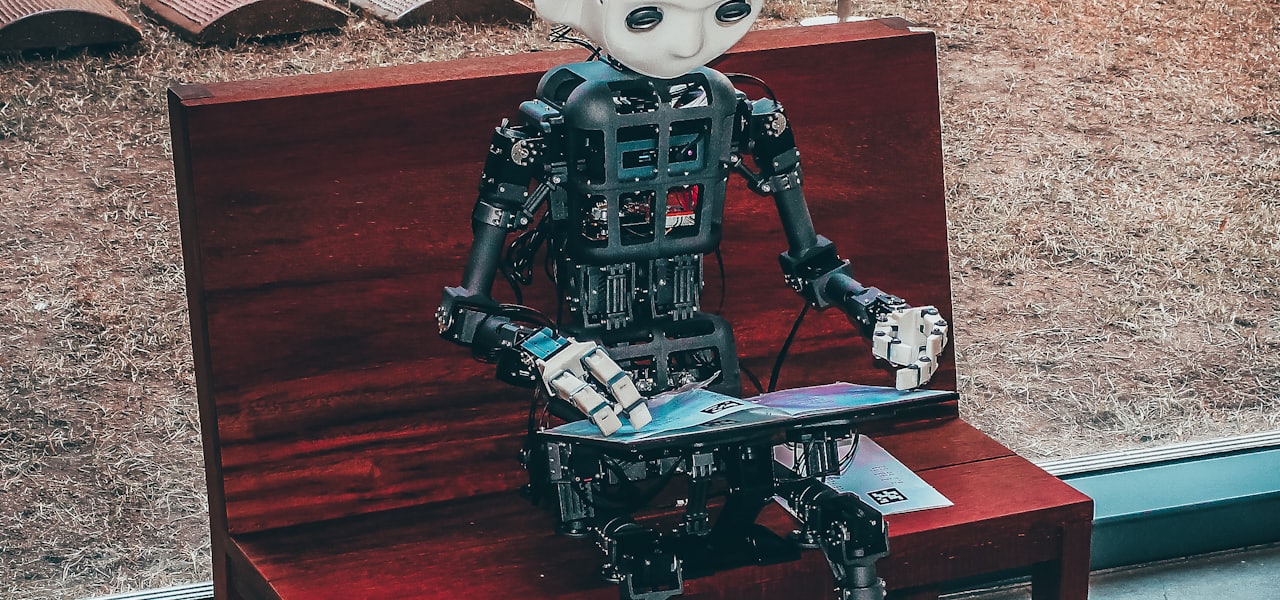
Personoid is the concept coined by Stanisław Lem, a Polish science-fiction writer, in Non Serviam, from his book A Perfect Vacuum (1971). His personoids are an abstraction of functions of human mind and they live in computers; they do not need any human-like physical body. In cognitive and software modeling, personoid is a research approach to the development of intelligent autonomous agents. In frame of the IPK (Information, Preferences, Knowledge) architecture, it is a framework of abstract intelligent agent with a cognitive and structural intelligence. It can be seen as an essence of high intelligent entities. From the philosophical and systemics perspectives, personoid societies can also be seen as the carriers of a culture. According to N. Gessler, the personoids study can be a base for the research on artificial culture and culture evolution. == Personoids on TV and cinema == Welt am Draht (1973) The Thirteenth Floor (1999)
Message queuing service
A message queueing service is a message-oriented middleware or MOM deployed in a compute cloud using software as a service model. Service subscribers access queues and or topics to exchange data using point-to-point or publish and subscribe patterns. It's important to differentiate between event-driven and message-driven (aka queue driven) services: Event-driven services (e.g. AWS SNS) are decoupled from their consumers. Whereas queue / message driven services (e.g. AWS SQS) are coupled with their consumers. Message queues can be a good buffer to handle spiky workloads but they have a finite capacity. According to Gregor Hohpe, message queues require proper mechanisms (aka flow controls) to avoid filling the queue beyond its manageable capacity and to keep the system stable. == Ordering Guarantees in Message Queues == Amazon SQS FIFO and Azure Service Bus sessions are queue-based messaging systems that provide ordering guarantees within a message group or session attempt but do not necessarily guarantee ordered delivery in cases of retries or failures. In SQS FIFO, messages in the same message group are processed in order, with subsequent messages held until the preceding message is successfully processed or moved to the dead-letter queue (DLQ). Once a message is placed in the DLQ, it is no longer retried, creating a gap in the sequence. However, the remaining messages continue to be delivered in order. Azure Service Bus sessions function similarly by maintaining ordering within a session, provided a single consumer processes messages sequentially. The implementation differs from SQS FIFO but follows the same fundamental ordering principle. In contrast, Apache Kafka is a distributed log-based messaging system that guarantees ordering within individual partitions rather than across the entire topic. Unlike queue-based systems, Kafka retains messages in a durable, append-only log, allowing multiple consumers to read at different offsets. Kafka uses manual offset management, giving consumers control over retries and failure handling. If a consumer fails to process a message, it can delay committing the offset, preventing further progress in that partition while other partitions remain unaffected. This partition-based design enables fault isolation and parallel processing while allowing ordering to be maintained within partitions, depending on consumer handling. == Vendors == Apache Kafka Apache Kafka is a distributed system consisting of servers that store and forward messages between producer client and consumer applications. IBM MQ IBM MQ offers a managed service that can be used on IBM Cloud and Amazon Web Services. Microsoft Azure Service Bus Service Bus offers queues, topics & subscriptions, and rules/actions in order to support publish-subscribe, temporal decoupling, and load balancing scenarios. Azure Service Bus is built on AMQP allowing any existing AMQP 1.0 client stack to interact with Service Bus directly or via existing .Net, Java, Node, and Python clients. Standard and Premium tiers allow for pay as you go or isolated resources at massive scale. Oracle Messaging Cloud Service This service provides a messaging solution for applications for asynchronous communication and is influenced by the Java Message Service (JMS) API specification. Any application platform that understands HTTP can also use Oracle Messaging Cloud Service through the REST interface. For Java applications, Oracle Messaging Cloud Service provides a Java library that implements and extends the JMS 1.1 interface. The Java library implements the JMS API by acting as a client of the REST API. Amazon Simple Queue Service Supports messages natively up to 256K, or up to 2GB by transmitting payload via S3. Highly scalable, durable and resilient. Provides loose-FIFO and 'at least once' delivery in order to provide massive scale. Supports REST API and optional Java Message Service client. Low latency. Utilizes Amazon Web Services. IronMQ Supports messages up to 64k; guarantees order; guarantees once only delivery; no delays retrieving messages. Supports REST API and beanstalkd open source protocol. Runs on multiple clouds including AWS and Rackspace. Scaling must be managed by user. RabbitMQ RabbitMQ is a reliable and mature messaging and streaming broker, which is easy to deploy on cloud environments, on-premises, and on your local machine. Supports AMQP, STOMP, MQTT StormMQ Open platform supports messages up to 50Mb. Uses AMQP to avoid vendor lock-in and provide language neutrality. Locate-It Option allows customers to audit the location of their data at all times and satisfy data protection principles. AnypointMQ An enterprise multi-tenant, cloud messaging service that performs advanced asynchronous messaging scenarios between applications. Anypoint MQ is fully integrated with Anypoint Platform, offering role based access control, client application management, and connectors.
Linguatec
The Linguatec Sprachtechnologien GmbH is a language technology provider, specialized in the field of machine translation, speech synthesis and speech recognition. Linguatec was founded in Munich in 1996 and its headquarters are in Pasing. Linguatec has won the European Information Society Technologies Prize three times. On their website, they are now using the online service Voice Reader Web, so that the information can be read out in every language by means of a text-to-speech function. == Core areas == Machine translation The different versions of Personal Translator (seven language pairs) can be used "for home use" or for professional business use in the company network. In addition to this, specialist dictionaries are offered to broaden standard vocabulary. Speech synthesis The Voice Reader text-to-speech program reads in twelve languages: German, British English, American English, French, Quebec French, Spanish, Mexican Spanish, Italian, Dutch, Portuguese, Czech, Chinese. Speech recognition Voice Pro is based on ViaVoice technology from IBM. There are special software programs for doctors and lawyers. == Patents == 2005 pending patent application for a newly developed hybrid technology that uses the intelligence of neural networks for machine translation. == Awards == 2004 European IT Prize for Beyond Babel 2004 test winner Stiftung Warentest – best voice recognition 1998 European IT Prize – applied voice recognition 1996 European IT Prize – automated translation == Studies == 2005 University of Regensburg: Voice Reader user test 2002 Fraunhofer Institute for Industrial Engineering and Organization IAO: user study on the efficiency of machine translation
Dyme (company)
Dyme is a Dutch fintech start-up and subscription management app that allows users to cancel and renegotiate their recurring costs. In 2019, Dyme was the first independent Dutch company to receive a PSD2 licence from the Netherlands' central bank (DNB). == History == Dyme was founded in 2018 by Joran Iedema, David Knap, David Schogt and Wouter Florijn. The four had previously founded Cycleswap, a bicycle rental platform launched in 2015 and sold to the American platform Spinlister in 2016. The company gained notability in the Netherlands in 2020 when it appeared on Dutch television in Dragons Den, where Pieter Schoen made a €750,000 bid in an attempt to acquire 51.01% of the company. Dyme's Joran Iedema rejected the deal. == Recognition == Wired described Dyme as one of the "hottest start-ups in Europe" in 2021. As of 2021, the company reportedly had 350,000 registered users in the Netherlands and Great Britain.
PhotoLine
PhotoLine is a general purpose bitmap and vector graphics editor developed and published by Computerinsel GmbH for Windows, macOS, and Linux/Wine. It was originally created in 1995 by Gerhard Huber and Martin Huber. The program combines bitmap and vector graphics editing in one seamless working application unlike most graphics software which tend to focus on either bitmap or vector editing and output. PhotoLine is considered as a market competitor to Adobe Photoshop. == Features == PhotoLine edits and composes multi-layer raster and vector images with deep support for masking and alpha compositing and with full color management. Editing and color management in PhotoLine is mostly non-destructive. Image data in layers is preserved without loss of information regardless of the document's image mode or layer transformation. color depth, image resolution, color model, and ICC profile are preserved for each individual layer or group of layers. Layers can be cloned and reused anywhere in the layer stack, including repurposed as layer masks. Layer blending and compositing in PhotoLine supports common blend modes, and features a layer blend range of -200 to +200 percent. It is also possible to control which channels are blended for each layer, adjustment layer, and layer mask or group of layers. Filters, adjustment layers, and brushes have access to Lab and HIS color modes (HIS is a variant of HSL), separately of the color model of the underlying image layer. In Addition to raster and vector editing, PhotoLine can be used for small desktop publishing projects. Multi-page documents with page spreads and text flow between text frames and pages are supported. Character and paragraph styles can be defined. Spot colors, bleed settings, a baseline grid, a table of contents generator, and PDF/X support help with these projects. PhotoLine is however much more limited when compared to dedicated publishing software such as Adobe InDesign or QuarkXPress. PhotoLine incorporates the Open-source software library LibRaw to read raw images from digital cameras for import. Developing these files is non-destructive with a choice of embedding the RAW image data either in the PhotoLine document or link to the external RAW image file. PhotoLine can open raw files as linear unmodified and non color managed source images. Photoshop PSD files can be imported and exported. Core functionality of PhotoLine can be extended through standard Photoshop filter plugins, the G'MIC digital image processing framework, and PSP tubes. External programs can be linked for a seamless round-trip workflow and files can be sent directly for processing in third-party design applications. Custom functionality is further supported through scripting and macro recording. == Early history == Developed by two brothers, Gerhard Huber and Martin Huber, PhotoLine was first released in January 1996 on the Atari ST line of personal computers from Atari Corporation. Previously, Gerhard and Martin had worked on making graphics cards for Atari computers and writing drivers for image scanners. Atari's market share was declining, and the brothers considered developing a video game to expand the business. This led them to search for image editing software that would run on Atari computers and fit their game project. Only an image editor called tms Cranach came close to what Gerhard and Martin had in mind. tms Cranach was a Raster graphics editor running on Atari's MegaST/STe, TT030, and Falcon030 systems. However, Cranach turned out to be expensive software and complicated to use. The brothers contacted tms (Cranach's developers) and this resulted in an offer from tms to purchase Cranach and its source code, as tms intended to exit the Atari software market. After the purchase of Cranach and its source code Gerhard and Martin initially continued to sell Cranach, but sales were low. In 1995 the two decided to start developing a new graphics editor called "PhotoLine". PhotoLine was developed from scratch and written in C++. It nevertheless contained a lot of know-how from Cranach (which was written in C). PhotoLine first release was launched one year later in 1996. With the growing popularity of Microsoft Windows, the release of Windows 95, and the limiting graphics hardware on the Atari platforms, the developers switched development platforms and continued development of PhotoLine for Windows only. The first Windows version (PhotoLine 2.2) was released in the middle of 1997. Shortly after, the Atari version was discontinued and saw its final release as PhotoLine 2.30. The Huber brothers released this final Atari version into the public domain in 2012. The first Classic Mac OS version of PhotoLine 6 appeared in 1999 after many ex-Atari users who had switched to Mac OS pressured the PhotoLine developers to release an Apple port. == Linux Support == PhotoLine runs natively under Windows and MacOS. While a native Linux version of PhotoLine is not available, running PhotoLine under Wine is actively supported and maintained by the developers. Running PhotoLine under Linux/Wine PhotoLine enables the user to allow Little CMS to fully support color management under Linux instead of the native OS CMS. == File format == Native PhotoLine files have the extension .PLD, which is an abbreviation of "PhotoLine Document". It can contain embedded JPEG, PNG, or camera raw images. It contains a preview image in JPEG or PNG format, which is used by the operating system or third-party applications to display a thumbnail of its contents. Thumbnails are natively supported on MacOS X. During installation on Windows the user is presented with an option to install a PLD thumbnail preview driver which enables thumbnails of PLD content in Windows Explorer. Alternatively, the FastPictureViewer Standalone Codec Pack provides the ability to display PLD thumbnails in Windows Explorer. == Version History == PhotoLine was first developed for the Atari ST computer. Version 2 was the first version for Windows, and since version 6 PhotoLine is also available for MacOS.
Common data model
A common data model (CDM) can refer to any standardised data model which allows for data and information exchange between different applications and data sources. Common data models aim to standardise logical infrastructure so that related applications can "operate on and share the same data", and can be seen as a way to "organize data from many sources that are in different formats into a standard structure". A common data model has been described as one of the components of a "strong information system". A standardised common data model has also been described as a typical component of a well designed agile application besides a common communication protocol. Providing a single common data model within an organisation is one of the typical tasks of a data warehouse. == Examples of common data models == === Border crossings === X-trans.eu was a cross-border pilot project between the Free State of Bavaria (Germany) and Upper Austria with the aim of developing a faster procedure for the application and approval of cross-border large-capacity transports. The portal was based on a common data model that contained all the information required for approval. === Climate data === The Climate Data Store Common Data Model is a common data model set up by the Copernicus Climate Change Service for harmonising essential climate variables from different sources and data providers. === General information technology === Within service-oriented architecture, S-RAMP is a specification released by HP, IBM, Software AG, TIBCO, and Red Hat which defines a common data model for SOA repositories as well as an interaction protocol to facilitate the use of common tooling and sharing of data. Content Management Interoperability Services (CMIS) is an open standard for inter-operation of different content management systems over the internet, and provides a common data model for typed files and folders used with version control. The NetCDF software libraries for array-oriented scientific data implements a common data model called the NetCDF Java common data model, which consists of three layers built on top of each other to add successively richer semantics. === Health === Within genomic and medical data, the Observational Medical Outcomes Partnership (OMOP) research program established under the U.S. National Institutes of Health has created a common data model for claims and electronic health records which can accommodate data from different sources around the world. PCORnet, which was developed by the Patient-Centered Outcomes Research Institute, is another common data model for health data including electronic health records and patient claims. The Sentinel Common Data Model was initially started as Mini-Sentinel in 2008. It is used by the Sentinel Initiative of the USA's Food and Drug Administration. The Generalized Data Model was first published in 2019. It was designed to be a stand-alone data model as well as to allow for further transformation into other data models (e.g., OMOP, PCORNet, Sentinel). It has a hierarchical structure to flexibly capture relationships among data elements. The JANUS clinical trial data repository also provides a common data model which is based on the SDTM standard to represent clinical data submitted to regulatory agencies, such as tabulation datasets, patient profiles, listings, etc. === Logistics === SX000i is a specification developed jointly by the Aerospace and Defence Industries Association of Europe (ASD) and the American Aerospace Industries Association (AIA) to provide information, guidance and instructions to ensure compatibility and the commonality. The associated SX002D specification contains a common data model. === Microsoft Common Data Model === The Microsoft Common Data Model is a collection of many standardised extensible data schemas with entities, attributes, semantic metadata, and relationships, which represent commonly used concepts and activities in various businesses areas. It is maintained by Microsoft and its partners, and is published on GitHub. Microsoft's Common Data Model is used amongst others in Microsoft Dataverse and with various Microsoft Power Platform and Microsoft Dynamics 365 services. === Rail transport === RailTopoModel is a common data model for the railway sector. === Other === There are many more examples of various common data models for different uses published by different sources.
KoalaPad
The KoalaPad is a graphics tablet, released in 1983 by US company Koala Technologies Corporation, for the Apple II, TRS-80 Color Computer (as the TRS-80 Touch Pad), Atari 8-bit computers, Commodore 64, and IBM PC compatibles. Originally designed by Dr. David Thornburg as a low-cost computer drawing tool for schools, the Koala Pad and the bundled drawing program, KoalaPainter, was popular with home users as well. KoalaPainter was called KoalaPaint in some versions for the Apple II, and PC Design for the IBM PC. A program called Graphics Exhibitor was included for creating slideshow presentations from KoalaPainter drawings. == Description == The pad was four inches square (i.e. roughly 10×10 cm) and mounted on a slightly inclined base with the back of the pad higher than the front. At the top, "behind" the pad, were two buttons. The pad hooked into the computer using the analog signals of the joystick ports (the so-called paddle inputs), which meant that it had a low resolution and tended to jostle the cursor if moved during use. As an alternative to the drawing stylus, the pad could as easily be operated by the user's fingers for tasks that demanded less precision, such as selecting between menu items (thus using the pad as a kind of "indirect touch screen"). The top-mounted buttons tended to be somewhat frustrating to use, as the user had to "reach around" the stylus to push the buttons in order to start or stop drawing. A similar tablet from Atari, the Atari CX77 Touch Tablet, addressed this with a built-in button on the stylus, which some enterprising users adapted for use with their KoalaPad. == KoalaPainter == The pad shipped with a simple bitmap graphics editor developed by Audio Light called KoalaPainter, PC Design or Micro Illustrator depending on the target machine (see release history). Although bundled with the pad, KoalaPainter could also be operated using an ordinary digital joystick. One unique feature of the program, for its time, was that it held two pictures in the computer's memory, allowing the user to flip from one to the other—a function commonly used in order to study the differences between an original and a modified picture, and to copy and paste between two different pictures. Some third-party bitmap editors could also be used with the KoalaPad, such as Broderbund's Dazzle Draw for the Apple II. === Release history === KoalaPainter for Commodore 64 (1983) and Atari 8-bit computers (1983) PC Design for the IBM PC (1983) Micro Illustrator for the Apple II (1983), Atari 8-bit computers (1983) and Commodore Plus/4 (1984) KoalaPainter II for Commodore 64 (1984) === Reception === Ahoy! called KoalaPainter "a very powerful and effective color drawing package", and concluded that it and the KoalaPad were "excellent in ease of use, a fine choice for a beginner as well as young children". BYTE's reviewer stated in December 1984 that he made far fewer errors when using an Apple Mouse with MousePaint than with a KoalaPad and its software. He found that MousePaint was easier to use and more efficient, predicting that the mouse would receive more software support than the pad. Cassie Stahl in InfoWorld's Essential Guide to Atari Computers praised the tablet and its documentation, rating it "Excellent" among all categories and stating that "Playing with the KoalaPad becomes addictive. It does everything it claims to, and it does it well". She also liked Micro Illustrator, rating it "Excellent" except for "Good" for Performance. While criticizing the limited erase function, Stahl reported an undocumented feature enabling exporting pictures to other software. === File format === The Commodore 64 version of KoalaPainter used a fairly simple file format corresponding directly to the way bitmapped graphics are handled on the computer: A two-byte load address, followed immediately by 8,000 bytes of raw bitmap data, 1,000 bytes of raw "Video Matrix" data, 1,000 bytes of raw "Color RAM" data, and a one-byte Background Color field. == KoalaWare == Koala Technologies offered more software beyond the bundled KoalaPainter and Graphics Exhibitor for use with the pad. Among these applications, marketed under the moniker KoalaWare (like KoalaPainter itself), was educational software for use with customized keypads and overlays, such as spelling tools, music programs, and mathematics instruction software, as well as software for "translating" graphical designs into Logo programs.